Galaxy Brain Survey
We are hitting escape velocity.
Just yesterday I wrote, "AI-generated tracks—will always be created, and our choice is whether to enable and compensate them properly, starting at the moment of creation."
It's a follow on to: Move, Human: Why Innovation in Music Rights Will Shape Our Creative Future
This is a perfect example of how compensation at creation and playback will ultimately enable more apps like this to flourish:
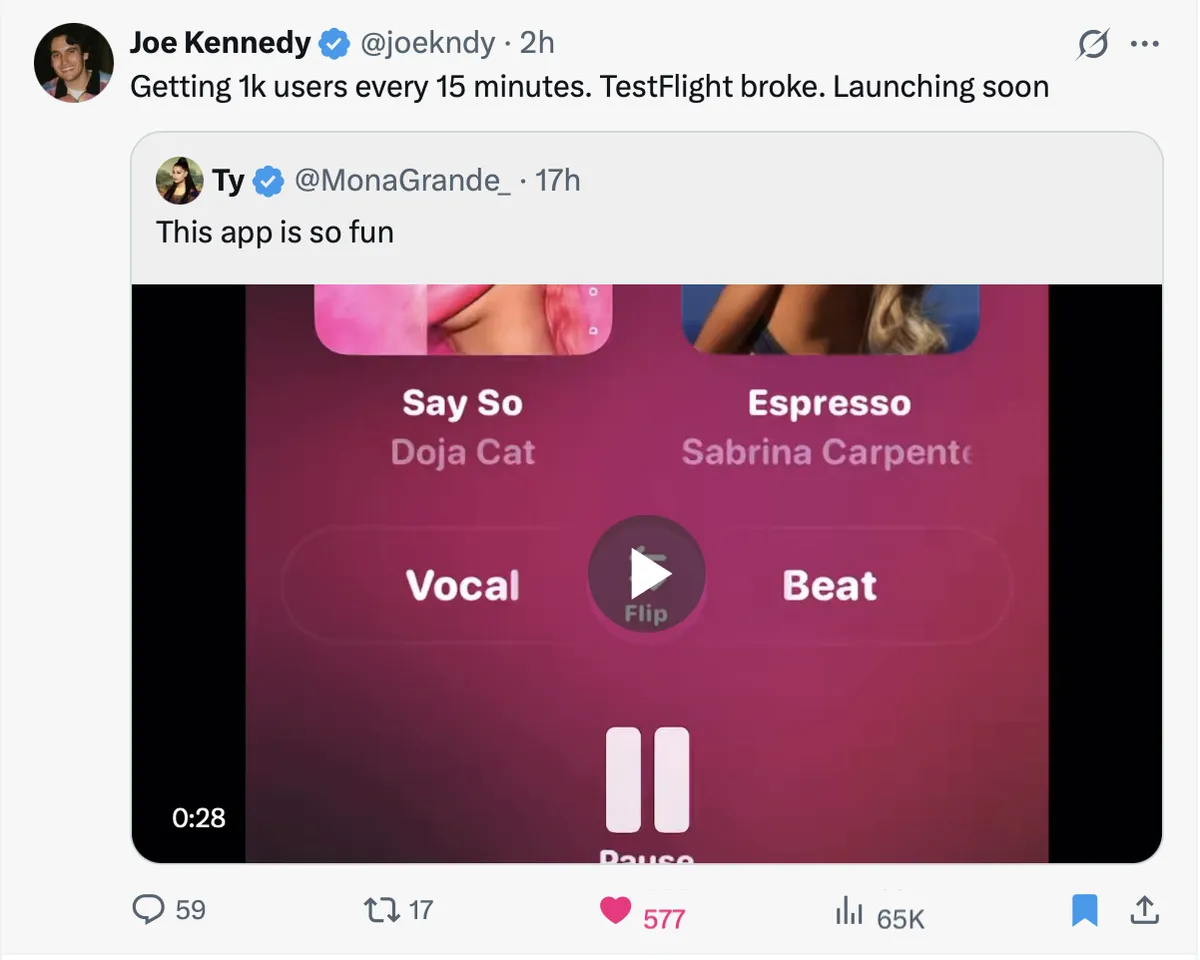
https://x.com/joekndy/status/1921923780676334071
https://usemixy.com
Galaxy Brain Survey
https://x.com/elonmusk/status/1921467596810915939
May 11, 2025
Parker Todd Broks & Grok 3
1. What is the hardest galaxy brain problem you’ve had to solve?
I’m Parker Todd Brooks, and the hardest galaxy brain problem I’ve tackled is building a music rights management system that embraces the reality that new and revised works of art—remixes, samples, AI-generated tracks—will always be created, and our choice is whether to enable and compensate them properly, starting at the moment of creation. At Apple, I helped pioneer the first-ever compulsory license for master recordings for DJ mixes, a beast of a challenge that required identifying tracks, mapping rights holders, and paying everyone fairly in an industry so fixated on distribution it can’t see the forest for the trees. Most language models or outsiders miss this—they’d toss out simplistic “blockchain solves all” clichés or treat it as a royalty tracking puzzle, failing to grasp that the industry’s century-long inertia blocks creators from making new works without legal or financial roadblocks. My work proved we can build systems to enable this inevitable creativity, but it demands rethinking rights, tech, and incentives from the ground up, not just tweaking streaming payouts.
2. What is the answer to that problem in one sentence?
Build a creation-first platform, like an enhanced GarageBand, where artists can access tracks, stems, or AI tools to create new and revised works, with automated, near real-time compensation for all rights holders baked into the process from the sample level up, ensuring fairness across creation, production, and redistribution.
3. What is the chain of thought that led to your answer? Step by step.
Step 1: Identified the industry’s distribution obsession
Working at Apple on DJ Mixes, I saw how the music industry fixates on monetizing music after it’s made—streaming, radio, sync deals—while creators struggle with legal and financial barriers to even produce a track. This felt like polishing a cart while the horse starved.
Step 2: Recognized the DJ Mixes model as a partial win
Our Apple DJ Mixes system was a breakthrough: we automated track identification, handled unidentified recordings, and paid rights holders and DJs pro-rata. It proved tech could make rights management equitable, but it only kicked in at distribution, not creation, which limited its impact.
Step 3: Pinpointed creation as the real bottleneck
From my time at Ledger, I saw Web3 platforms bypass rights frameworks with “upload and get crypto” models, which ignored a century of music rights evolution. Meanwhile, AI tools like Suno were creating music that could outpace human creators because they faced no creation-stage friction. The real issue was clear: creators need systems that make music-making legally and financially accessible.
Step 4: Connected the dots to sampling and stems
Sampling has always been a legal minefield—lawsuits, high clearance costs, or outright bans. If we could extend the DJ Mixes model to handle samples and stems at the creation stage, we’d unlock creativity while ensuring rights holders are paid. This would mirror how DJ mixes work but start earlier in the process.
Step 5: Envisioned a creation-first platform
I imagined a GarageBand-like system where artists could pull any Apple Music track or stem, remix or reimagine it with AI, and have rights holders compensated in near real-time. Metadata would track every contributor, so payments flow through production and redistribution. This wasn’t just about distribution—it was about making creation frictionless and fair.
Step 6: Acknowledged the industry’s mindset
The industry only cares about redistribution because that’s where they see revenue. By framing this as an extension of the DJ Mixes model, I could sell stakeholders on a creation-first system by speaking their language—monetization—while quietly revolutionizing how music is made.
Step 7: Landed on a scalable, practical solution
The tech already exists: Apple’s track ID algorithms, payment systems, and metadata frameworks can be repurposed for creation. The answer isn’t some cosmic blockchain fantasy—it’s a practical platform that starts compensating at the sample level and scales to every playback stage, ensuring creators and rights holders win.